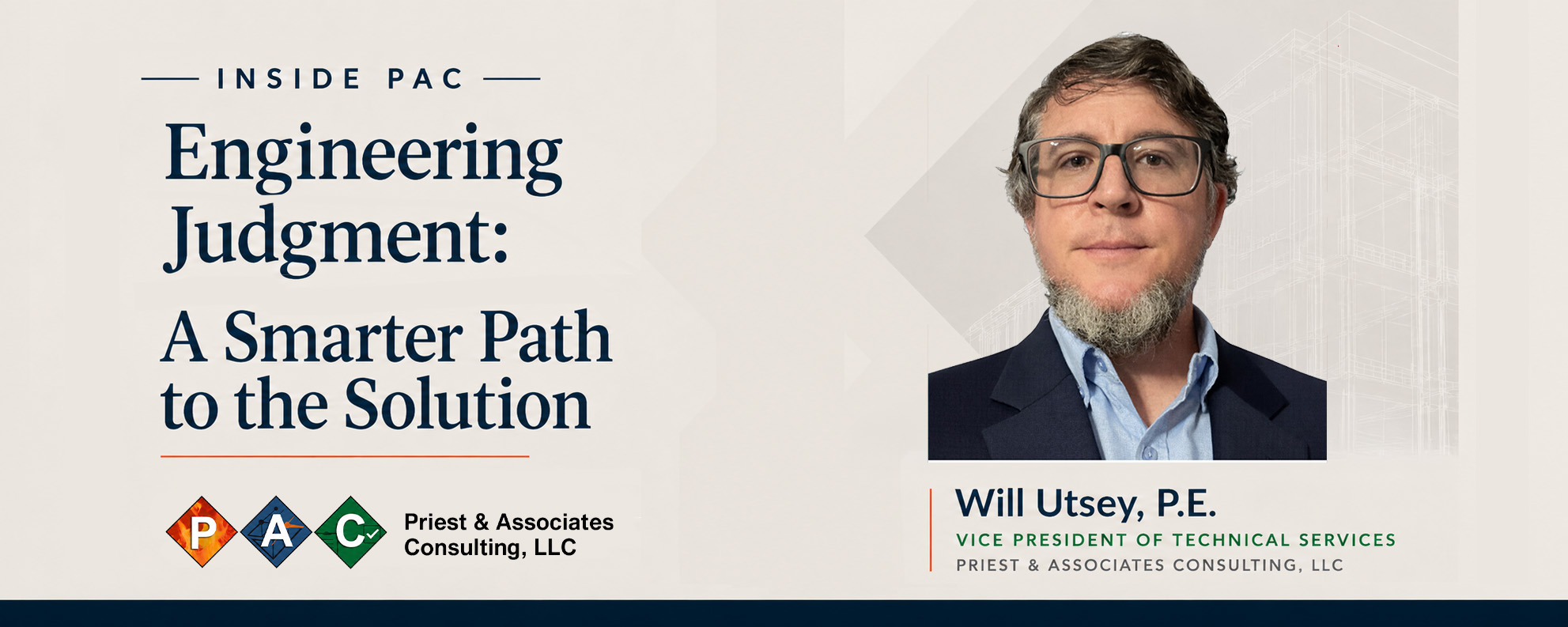
Engineering Judgment: A Smarter Path to the Solution
A conversation with Will Utsey, P.E. Vice President — Priest & Associates Consulting
When Testing Isn't the Only Answer
For building-product manufacturers, a product-performance or code-compliance question doesn't always require another round of testing.
When technically supportable, PAC can use existing data and sound engineering principles to develop an engineering judgment that addresses the question more quickly and economically.
For Will, this engineered approach is one of the most valuable things PAC brings to its clients.
“PAC’s engineered approach to developing judgments is extremely valuable.”
Rather than automatically assuming additional testing is necessary, we can first examine what information already exists and determine whether it can support a defensible solution.
The result can be a faster, more economical path toward resolving a technical or compliance question.
A Phased Approach to Engineering Judgments
One of the things Will believes sets us apart is how the firm approaches the process.
PAC typically begins with a limited research and analysis phase. The purpose is straightforward: determine whether an engineering judgment can be technically supported before the client commits to the full cost of the final deliverable.
If the analysis supports moving forward, we can explain the technical basis to the client and provide the option to proceed with the formal engineering judgment.
“This approach gives clients an informed answer before they commit to the full cost of the final deliverable.”
It's a practical approach that allows manufacturers to make a more informed decision about the path forward.
Research first. Understand the options. Then proceed with confidence.
Experience That Goes Beyond Engineering
There is another part of PAC that Will believes people outside the company may not fully realize: the depth of experience within the team.
PAC team members have worked within:
- ISO/IEC 17065-accredited certification bodies
- ISO/IEC 17025-accredited testing laboratories
- Leadership roles, including vice-president and comparable positions
That experience provides us with an understanding of more than engineering principles alone.
It gives the team insight into testing, certification, product evaluation, and the practical challenges manufacturers face when trying to bring products through the approval process.
For clients, that perspective can be valuable when determining not just what needs to be done, but how the process may actually work in practice.
The Engineer's Role: Solve the Unfamiliar
One project particularly stands out to Will because it involved a product and application he wasn't initially very familiar with.
Rather than treating the unfamiliarity as a limitation, he approached it as an engineering problem.
He thoroughly studied the subject, researched the relevant technical requirements, and ultimately became comfortable developing a supportable engineering judgment.
“It demonstrated what engineers are trained to do: understand unfamiliar problems, apply sound engineering principles, and reach defensible conclusions.”
It's a simple idea, but an important one.
Engineering isn't always about already knowing the answer.
Sometimes it's about knowing how to find it.
Looking Beyond Fire
Fire-related applications remain an important part of PAC's work, but Will sees an opportunity to expand the industry's understanding and use of engineering judgments beyond fire.
The same disciplined approach can be applied to other aspects of building-product performance, including:
Load Resistance Durability Product Performance
Expanding into these areas could allow PAC to solve a broader range of client challenges while continuing to establish the company as a leader in building-product engineering judgments.
“Applying the same disciplined approach to other aspects of building-product performance—including load resistance and durability—will allow PAC to solve a broader range of client challenges.”
The PAC Perspective
Will's perspective highlights an important part of PAC's approach:
Not every problem requires starting over.
Sometimes the answer is already within the available data, existing testing, applicable requirements, and sound engineering principles.
The key is knowing how to evaluate that information, determine what is technically supportable, and develop a defensible path forward.
Research. Analyze. Engineer. Resolve.
That's the value of an engineering judgment.
|