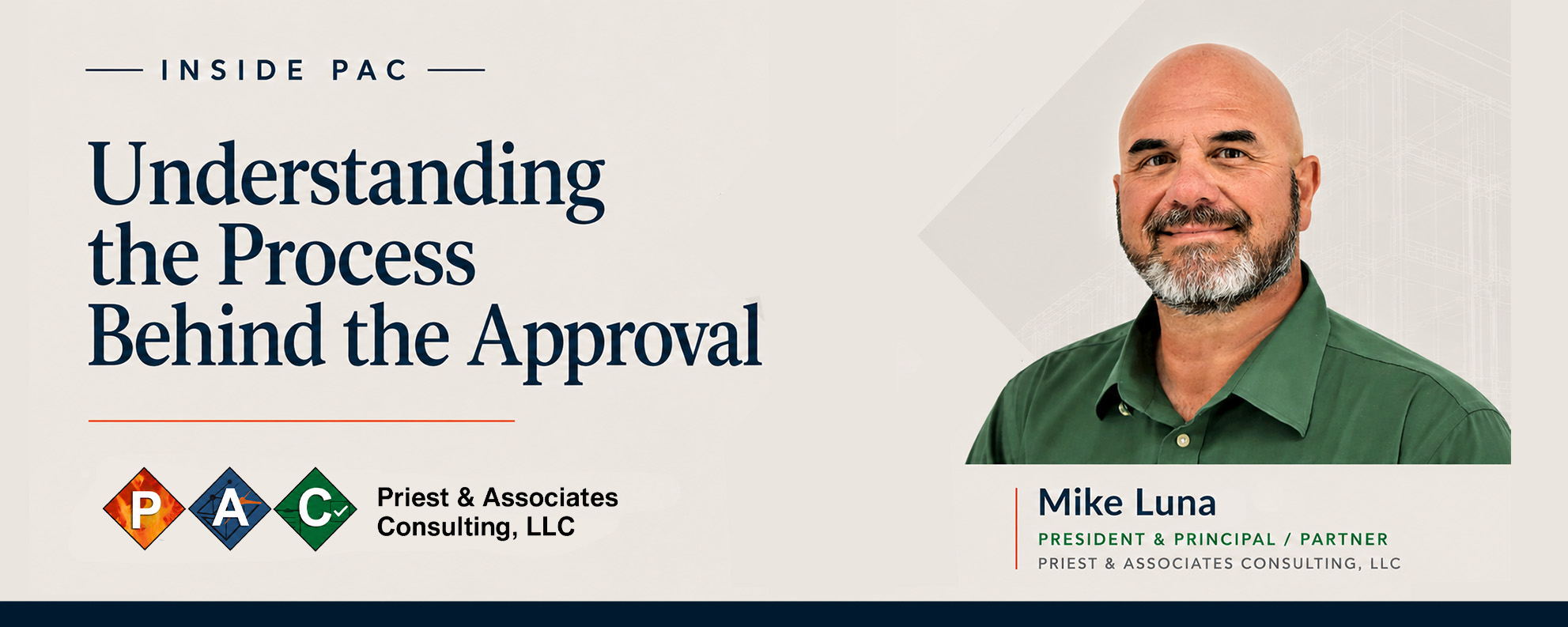
Understanding the Process Behind the Approval
A conversation with Mike Luna, President & Principal / Partner at Priest & Associates Consulting
When manufacturers are navigating testing, certification, and product approval, knowing the applicable codes and standards is only part of the equation.
For Mike, one of our greatest strengths comes from understanding what happens throughout the entire process, from developing a test program to working with testing laboratories and certification agencies and ultimately getting a product approved.
"PAC’s value comes from understanding the entire testing and certification process, not simply the applicable codes and standards."
That experience gives PAC the ability to help manufacturers identify the most effective approval path, select and construct the right test assembly, and make sure testing is performed properly.
Because a poorly planned test can cost significant time and money, our role is not simply to help clients meet a requirement. It's to help them get the greatest possible value from their testing and certification programs.
What Makes PAC Different?
One of the first things Mike points to is something that can have a major impact on a project: responsiveness.
PAC understands that a delay doesn't always stay a delay. It can affect a product launch, a construction schedule, an approval, or ultimately a manufacturer's revenue.
"We provide a very fast turnaround on both proposals and project work because we understand that delays can affect product launches, construction schedules, approvals, and revenue."
But speed is only part of the equation.
Mike emphasizes that we combine responsiveness with practical industry experience. Rather than approaching a project solely as an academic engineering exercise, PAC considers how the testing laboratory, certification agency, code official, architect, manufacturer, and contractor may each view an issue.
That broader perspective helps us develop solutions that are not only technically sound, but also practical and more likely to be accepted.
PAC Is More Than Fire
Fire engineering and fire testing remain important parts of our expertise, but Mike sees an important misconception that still exists about the company.
"Many people still think of PAC primarily as a fire-engineering and fire-testing consulting firm. Fire remains one of our core strengths, but our capabilities have expanded considerably."
Our capabilities have expanded well beyond fire-related work.
Today, the firm also provides consulting involving:
- Structural performance
- Wind resistance
- Acoustics
- Roofing
- Other non-fire-related building-product testing and approval needs
For manufacturers, that broader capability can mean fewer consultants to coordinate and a more streamlined approach to addressing multiple technical and certification requirements.
One relationship. Multiple technical needs.
When Technical Expertise Solves a Real-World Problem
One of Mike's most memorable projects involved a construction condition that had not been built as originally intended.
The initial concern was significant: a substantial amount of completed construction could potentially have needed to be removed and rebuilt.
Instead of immediately jumping to corrective work, PAC dug into the applicable codes, standards, tested systems, and actual construction conditions. The team also drew on its relationships throughout the building-product industry to better understand what was technically supportable.
The result was a defensible solution that substantially reduced the amount of corrective work required, and saved the parties tens of thousands of dollars, potentially much more.
"We did not compromise safety or code compliance to reduce cost."
For Mike, that's what makes this kind of project particularly meaningful.
We weren’t simply looking for the cheapest answer. The goal was to understand the actual risk, determine what could be supported technically, and find a practical path forward.
"That is when our work has the greatest value: when sound technical analysis solves a real-world problem and prevents unnecessary expense."
Looking Ahead: Making Compliance Part of the Design
Mike sees PAC's biggest future impact coming from helping manufacturers obtain approvals more efficiently as well as moving compliance conversations earlier in the process.
Manufacturers can face long testing and certification lead times. By helping develop testing strategies and anticipate certification requirements earlier, PAC can help clients avoid mistakes that could result in delays or additional testing.
But Mike sees an opportunity beyond manufacturers.
We are exploring a potential subscription-based resource for architects and design professionals that could help answer compliance questions earlier in the design process.
The goal would be to help determine:
Is this assembly already supported?
Is an Engineering Judgment or other approval available?
What additional work may be needed?
Getting those answers during design could help prevent redesign, delays, and costly corrective work.
"Addressing those questions during design, rather than after products have been specified, purchased, or installed, could prevent delays, redesign, and expensive corrective work."
And ultimately, Mike sees us as being uniquely positioned to help connect the different sides of the industry.
"PAC is especially well-positioned to connect manufacturers, testing and certification agencies, and the architectural community so that technically sound decisions can be made sooner."
The PAC Perspective
Mike's perspective highlights something fundamental about PAC:
Compliance isn't just about knowing the code or standard.
It's about understanding the process, the people, the testing, the approvals, and the real-world conditions that determine whether a product can successfully move forward.
From helping manufacturers plan testing more effectively to finding practical solutions when unexpected problems arise, our value comes from connecting technical expertise with real-world application.
Because the best solution isn't just technically correct.
It's one that works.
|